How we change what others think, feel, believe and do
|
|
How we change what others think, feel, believe and do |
The Need for a Sense of Control
Explanations > Needs > Sense of Control Control is a deep, deep need | The control trap | So what?
No, this is not so much about how to control people as about their needs around control. The real secret is the deep, deep need that people have for a sense of control. In persuasion, by managing how they feel about control, you can achieve far greater actual control. If you ignore this need, you might easily fall into a power battle for control of the conversation and the agenda. Control is a deep, deep needPerhaps the deepest need people have is for a sense of control. When we feel out of control, we experience a powerful and uncomfortable tension between the need for control and the evidence of inadequate control. Note that the need is for 'a sense of control', not just for 'control'. This need around how we feel about control is much deeper and has a wider scope than just seeking power and the control it brings. One of the most disturbing things about having a terminal illness, as those who unfortunately suffer from such afflictions will tell you, is the feeling of powerlessness, of being unable to do anything about it. Being unable to control the illness and knowing that others cannot help either can be even more painful than impending death. From an evolutionary standpoint, if we are in control of our environment, then we have a far better chance of survival. Our deep subconscious mind thus gives us strong biochemical prods when we face some kind of danger (such as the fight-or-flight reaction). Other needs that lead to a sense of control include:
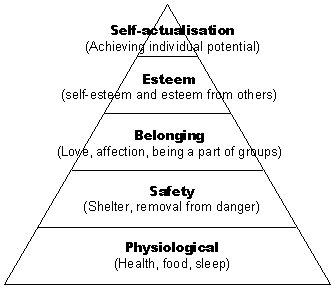
Maslow revisitedPsychologist Abraham Maslow defined a hierarchy of needs, with the particular revelation that when lower level needs are not met, then higher-level needs will be abandoned in favor of shoring up the deeper needs. Take a look at the needs:
Notice how the lower you go, the more important control is. We work hard to control disease and our susceptibility to it. Being ill gives a terrible sense of being out of control. Likewise for having a roof over our head (or not), and even in our social environments. Beyond basic Maslow, there is a sequence of acknowledgement (recognizing the person), approval (evaluating the person) and acceptance before a person is admitted to a group and so achieve the need for belonging. With further approval they gain respect, esteem and consequent status, in which they gain power and consequent control. Not control, just the senseIn fact, we don't actually need to be in control all of the time. What we really seek is a sense of control. When our parents or our managers are controlling us, we can still be happy because we trust them to provide the control we seek in our lives. In fact many people actively seek parent-figures in all walks of their life who will provide this control. When seek the advice of experts and obey those in authority, we are depending on them for our sense of control. Control is embedded in much of what we doLook around and watch what people do. A significant portion of our everyday activity is related to achieving our much-needed sense of control. Rituals, for example, are everywhere. Why do we have them? They exist to reassure people everything is as it was and to provide a familiar framework for our daily lives. Social norms and values tell us what to do, what is right and wrong, what is good and bad. When everyone in the group follows the rules, we feel a sense of control. Power and trustThe sense of control is closely related in opposite ways to power and trust. You can get a sense of control by taking control and acting, which is effectively about power. You can also get a sense of control by ceding it to others, which requires trust. Trust and control support one another. Not only does trust cede control, but the need for a sense of control drives us to seek trust, otherwise we implement trust substitutes, such as monitoring or barriers. Control and riskIf we have control then we risk less. Threats can be avoided or handled. This has significant evolutionary benefit as it leads to a better chance of survival. We trust more and risk less when we have control. In this way powerful people will trust others more easily. Vulnerable people, on the other hand, can do little about avoiding threats and so must depend on others to help them. Pain and controlPeople who have a higher sense of control tend to feel pain less intensely. This is probably because a person who feels they are not in control also feels vulnerable to attack and starts to imagine being hurt and so feels some psychologically created pain. When real pain appears they simply feel worse. Locus of controlThere is a principle of locus of control whereby we tend to attribute control in our lives either internally (I have control) or externally (others control my life). People with an internal locus of control are more proactive and self-motivated. External attribution leads more to passivity and belief in fate or luck. Harmony and controlA loss of the comfortable state of harmony that we seek has been defined as shift towards either chaos or rigidity (Siegel 2008). When we become more rigid, we control more. When we become more chaotic, we control less. Harmony and integration can hence be understood as a balance of control. The control trapThere is a trap into which many sales people and other would-be persuaders fall. This pitfall is to try to hold tightly to the reins of control throughout the whole process. Grabbing control causes resistanceWhen I grab control of the conversation, talking past the point when you want to reply, you will get increasingly frustrated as you wait for a pause in which you can respond. Sales people do this when they insist on going through the whole sales pitch even when the customer just wants to pay, take the product and leave. Parents do it when they over-do the lectures to their children. A point which is initially accepted is later rejected at what gets seen as unfair punishment. Taking direct control of a conversation or situation does not persuade. It is possible that you get temporary compliance, but you will not get true persuasion. Fishing is a delicate gameThe control game is much like fly fishing. Pull to hard and the fish will slip the hook. Let it out too far and the line will snag or the fish will swim away. It is only through a sometimes-long process of give and take, you steadily reel in your fish. So what?So manage the other person's sense of control by changing those things that make them certain, able to understand and predict the things around them. This can be done by making things uncertain and inconsistent. Giving control to get controlGiving up control gets control in two ways. First, by choosing when, where and how you give control, you still have hold of the reins. You have defined the cage in which the other person can play. Secondly, having allowed them to exercise control, you can evoke the reciprocity principle, such that the other person will willingly give up control of the conversation to redress the social balance. As someone said long ago, 'Give, in order that ye shall receive'. Give them choiceWhen people exercise choice, they are controlling their environment. So give them a choice, ensuring that whatever they choose gives you an advantage. One of the most common sales closes is the alternative close, where you assume the other person is ready to buy, and give them a simple choice ('Do you want the red one or the yellow one.'). Don't give them too much choice, because this makes the decision harder and can thus lead to a reduced sense of control. Because we make our easiest decisions by contrasting two things at one time, the best number of options to give is two. Open questionsClosed questions do not give control. In fact they can seem very controlling. Open questions give people the floor, letting them talk. This can be a scary step and can indeed lose all control. But you are the person who asked the question, so choose the question well to contain their response and possibly even give you information. Just having them talk is itself a great persuader. When people talk about something themselves, they are far more likely to believe in it than if they just sit back and listen to you. Give them something to doThe corollary of questioning is to give them something active to do. Just like when they are talking, actively doing something, especially when they have choice, gives a sense of control. As with questioning, when you are directing the action, you are still in overall control. ReflectingPeople often keep talking because they are not sure that you have really understood what they have said. When you reflect back to people what they have told you, you show them that you have heard, that they have been successful, that they have controlled their environment. This will speed the point at which they will give you back the talking stick. See alsoIdentity, Novelty, Control-Identity types, Locus of Control, What is Luck?
Siegel, D. (2008). Mindsight, Oxford: Oneworld
|
Site Menu |
|
| Home | Top | Quick Links | Settings | |
|
Main sections: | Disciplines | Techniques | Principles | Explanations | Theories | |
|
Other sections: | Blog! | Quotes | Guest articles | Analysis | Books | Help | |
|
More pages: | Contact | Caveat | About | Students | Webmasters | Awards | Guestbook | Feedback | Sitemap | Changes | |
|
Settings: | Computer layout | Mobile layout | Small font | Medium font | Large font | Translate | |
You can buy books here |
|
And the big |
|
| Home | Top | Menu | Quick Links | |
|
|
Site Menu |
|
| Home | Top | Quick Links | Settings | |
|
Main sections: | Disciplines | Techniques | Principles | Explanations | Theories | |
|
Other sections: | Blog! | Quotes | Guest articles | Analysis | Books | Help | |
|
More pages: | Contact | Caveat | About | Students | Webmasters | Awards | Guestbook | Feedback | Sitemap | Changes | |
|
Settings: | Computer layout | Mobile layout | Small font | Medium font | Large font | Translate | |
|
| Home | Top | Menu | Quick Links | |
|
|